Currently, the ProudNet DB system only works on Windows.
Game databases are characterized by small transaction sizes, many accesses, and most of the data is repeatedly fetched and stored. The ProudNet database system caches this process to reduce the load on the database.
Structure of DB Cache data
Data stored in the game database is handled in tree units, and this tree is composed of nodes.
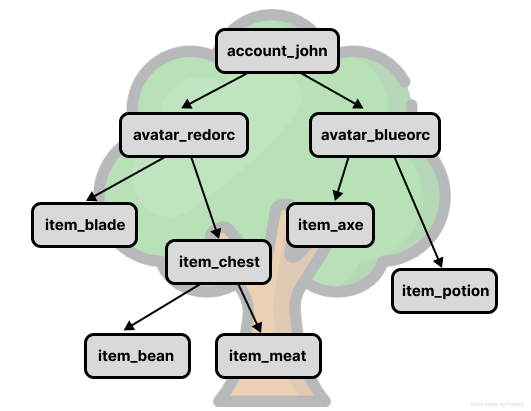
Each node has a parent, child relationship, and each node has a name-value pair, or property field.
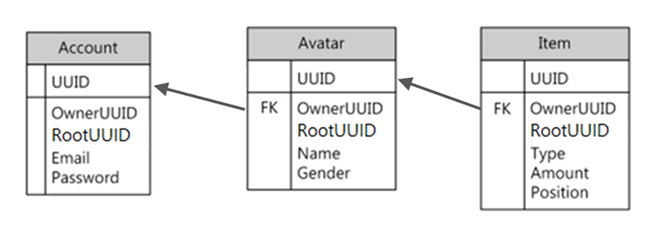
The table name of the root node, which is the highest node of the data tree being loaded, and the table name of the child nodes must be different.
Data access types for DB Cache
In a DB cache, the default usage is to exclusively load and handle data, and the ProudNet DB system provides the following types of access.
| Access Type | Use case examples | Cache or not | Immediate return | Whether exclusive loading is required | Internal processing |
|---|---|---|---|---|---|
Making unilateral data changes | Frequent information changes for player characters during gameplay | YES | YES | YES | Cache first in memory and then write to DB |
Changing request-responsive data | Create a player character with a unique name | NO | NO | YES | If successful after writing to DB, cache in memory |
Accessing non-proprietary data | Purchasing paid items on your web server | NO | NO | NO | If successful after writing to DB, cache in memory |
- Exclusive load
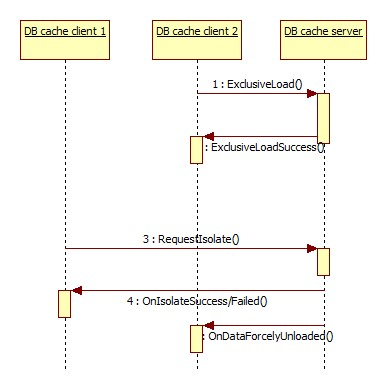
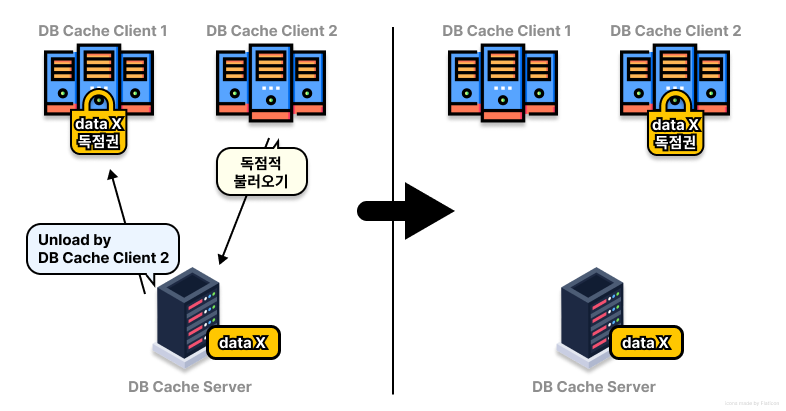
To avoid race conditions, the DB cache system allows only one DB cache client to load the same data, which is called an exclusive load.
If the DB Cache System is already monopolized by one DB Cache Client and a new DB Cache Client requests exclusivity, the previous DB Cache Client will receive a request to transfer exclusivity and can accept or reject it. At this time, if the previous DB Cache Client unloads data, the new DB Cache Client will receive exclusive rights.
(1) Making unilateral data changes
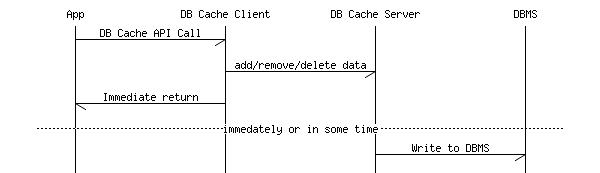
When you make a unilateral data change, the data is immediately reflected in memory in the DB cache, and the change is actually written to the database some time later, i.e., the data is cached. Because the unilateral data change processing returns immediately, there is no latency in the routine that changes the data, so there is no need to wait for the result to complete after the data change.
The unlock then lock process is not required as in the routine below.
UpdateSomeData()
{
    lock(X);
    ...
    unlock(X);
    UnilateralUpdateSomeData(X);
    lock(X);
    ...
    unlock(X);
}
Unilateral data changes are applied unconditionally to memory in the DB cache, but the changes might not be reflected in the records for which you set DB Constraints on the database.
For this reason, we recommend that you do not set DB Constraints, or if you do, use them only when you are sure. In a typical online game, database objects for gamers and objects in the world region can safely use unilateral data changes.
(2) Changing request-responsive data
Request-response data change is a request-response type, which works in the opposite way to unilateral data change. The DB cache client requests the DB cache server to change the request-response data and actually records it in the database to determine whether the recording is successful through the DB cache client.
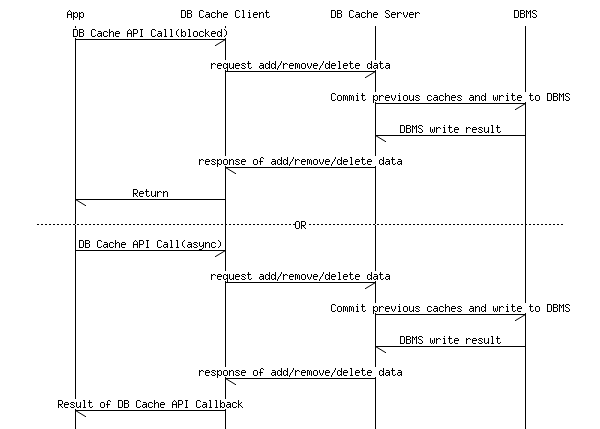
Request-response data changes are not really cache in the sense, but they do not reflect the changes in the DB cache until the actual record is successful, reducing the probability of record failures due to DB Constraints. When creating player characters that prohibit duplicate names in online games, we typically use request-response data changes.
(3) Accessing non-proprietary data
Unilateral data changes and request-responsive data changes are limited to exclusively loaded data.
However, there are times when you want to read or write data that has already been exclusively loaded from another DB cache client. There may be cases where it is necessary to view or change the character information of a logged on player in an operation tool, such as when viewing the player character's information on a web server or adding or changing an item to the player character's bag on a paid item payment server.
Accessing non-proprietary data is a feature for this purpose.
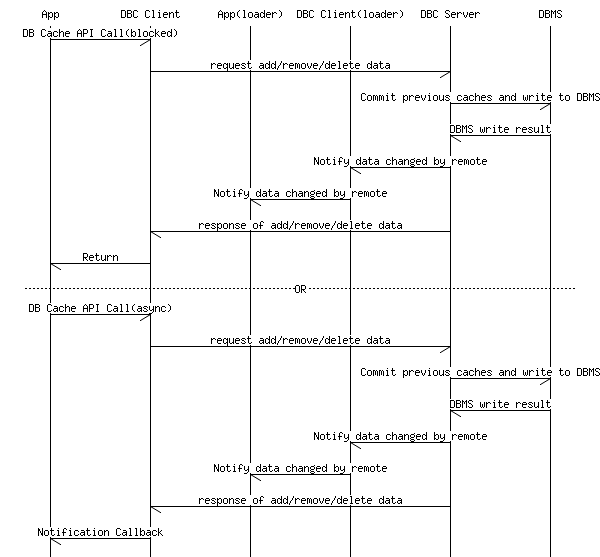
All non-proprietary data access operates in a request-responsive data changes manner, so it does not respond immediately, but is resistant to DB Constraints. Additionally, when data is changed non-exclusively, the DB cache client that loaded exclusively is notified that the data has been changed by another source.
Direct DB access to data covered by the DB cache
The data status of the data tree loaded and handled by the DB cache is maintained in a more up-to-date state than that in the DB. This is because data is written to the DB cache first and then to the DB later.
As a result, if a user writes data directly to the DB, apart from the data tree covered by the DB cache, undesirable errors can occur because the data in the DB is slightly older.
This is a similar problem to the data race condition.
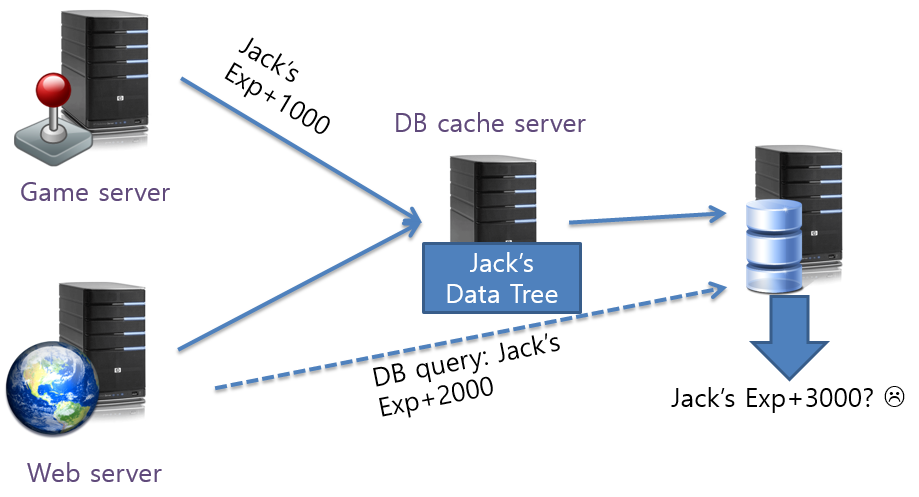
ProudNet provides data isolation to avoid data race condition when trying to handle data tree handled by DB cache directly in the DB, which completely disenables the user's desired data tree from DB cache to prevent data race condition from occurring even if the DB is accessed directly.
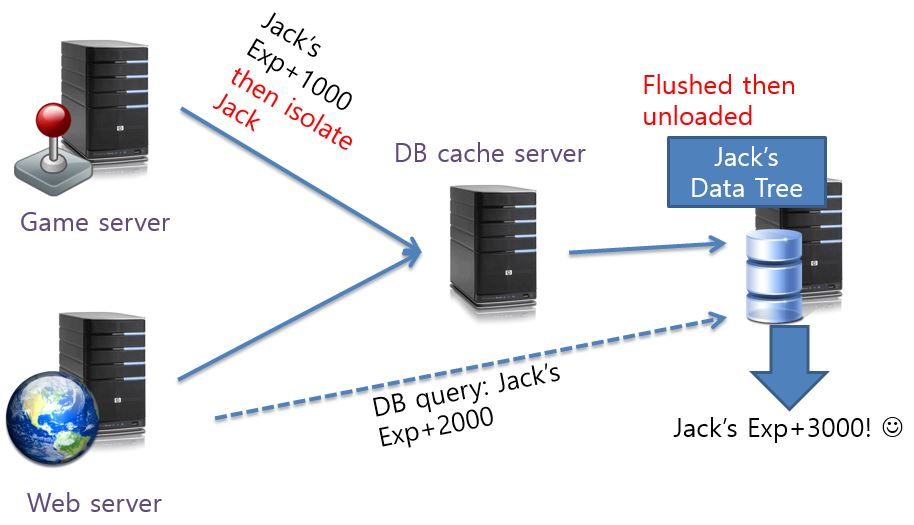
The instructions are as follows.
If you call Proud.CDbCacheClient2.RequestIsolateData(X) for a data tree that needs to be accessed directly from the DB, X will be isolated, and if X is already loaded, it will also be unloaded.
Once Proud.IDbCacheClientDelegate2.OnDeisolateDataSuccess(X) is called, you can safely access X in the DB.
If X is isolated, the DB cache cannot load it.
If you have completed DB access to X, call Proud.CDbCacheClient2.RequestDeisolateData() to release isolation.